

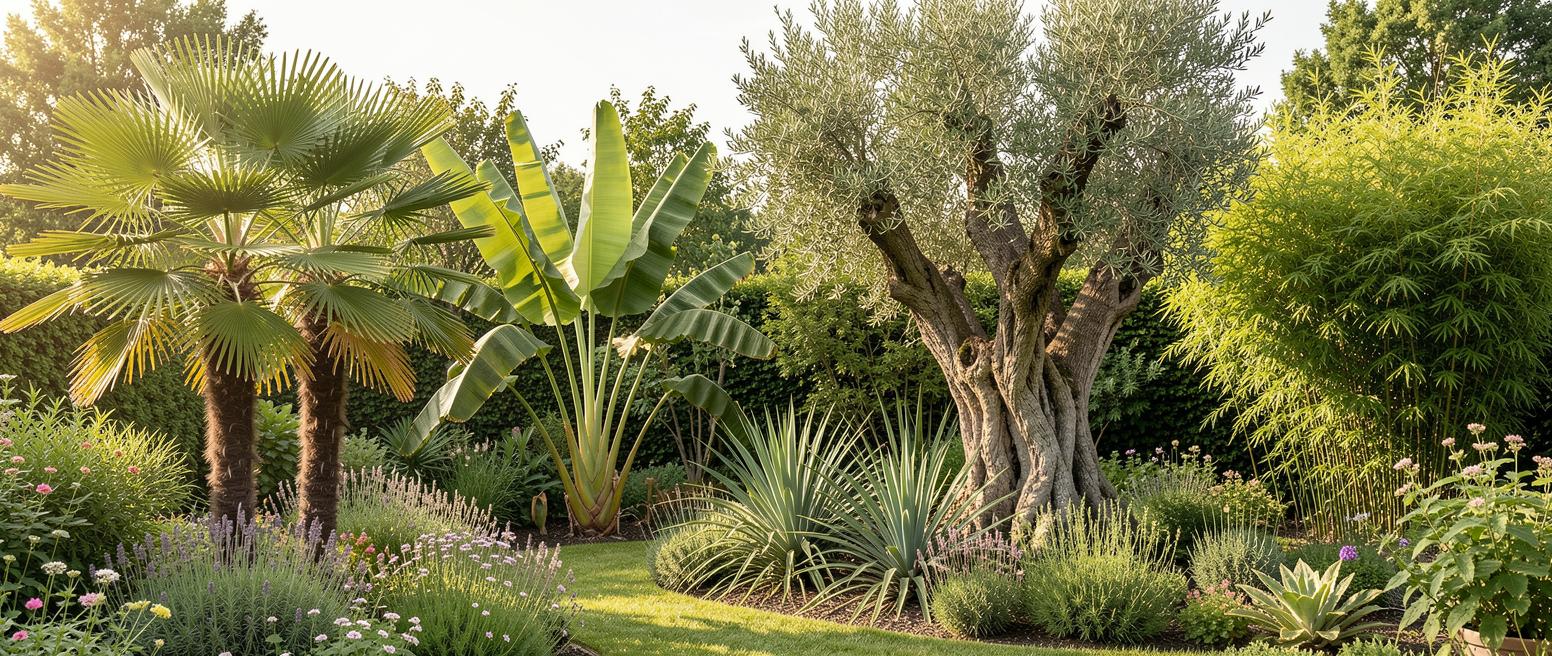
Almost every Mediterranean plant can grow in the Netherlands. The only question is which one suits you: in the ground, in a pot that goes indoors in winter, or simply in the living room.
Our assortment at a glance
The range of palms and Mediterranean plants is vast, making it difficult to choose. This guide lists all groups: what they look like, how much cold they can tolerate, and for which location they are intended. This way, you'll know what you're getting before you order.
Teeninga Palmen is an online tropical garden center. Tropical, for us, primarily means Mediterranean: plants from areas around the Mediterranean Sea and beyond that you wouldn't normally find in a Dutch garden. Of these species, we have selected a large number that can cope with our climate.
All plant groups at a glance

Roughly, the assortment is divided into seven groups. They differ mainly in two things: how much frost they can tolerate and how fast they grow.
Those who want to fill a garden in one season look at bananas and bamboo. Those who want something that remains the same for years choose a palm, yucca, or olive tree.
- Hardy palm trees: stay outdoors all year, evergreen, slow to moderately fast growing.
- Banana plants: very fast growers with large leaves, usually require winter protection.
- Yucca plants: desert plants, little water, slow growing, exceptionally hardy.
- Olive trees: characteristic trunks, from tabletop models to centuries-old specimens.
- Bamboo: fast, strong, and ideal as a hedge, in spreading and non-spreading varieties.
- Flowering plants: from hardy lilac to tropical Heliconia.
- Tropical palms and cycads: for indoors or a heated space.
Banana plants

Banana plants immediately give a jungle look. They consist largely of water and grow exceptionally fast: a plant can grow several meters in one summer. The well-known giant leaves are their trademark; bananas in the Netherlands are a bonus, not a promise.
Musa basjoo, the Japanese fiber banana
The most popular species, for two reasons: it grows very quickly and it is the hardiest banana plant we carry. The leaves can tolerate a perceived temperature of about -7 °C, the roots go down to about -18 °C. Cut off the leaves at the trunk in winter; they will die anyway, and the plant saves energy this way.
Ensete ventricosum 'Maurelii', the red banana plant
Less hardy and without bananas, but with beautiful reddish-purple leaves that grow a meter long and a thick trunk. In a pot, it grows 200 to 300 cm tall here. After about three years, burgundy flowers appear at the top. The roots tolerate up to -7 °C; preferably bring it indoors in winter.
Musella lasiocarpa, the Chinese lotus banana
Remains relatively small but produces a yellow flower up to 20 cm in diameter with a scent that attracts butterflies. For this species, do not cut off the leaves: let it overwinter indoors, otherwise it will not flower.
Musa 'Da Jiao', the plantain
A hybrid of Musa sikkimensis and Musa balbisiana, with wider and stronger leaves that are less prone to wind damage. The underside of the leaf has a white haze. It tolerates a few degrees of frost, but preferably let it overwinter in a frost-free environment.
Musa acuminata 'Dwarf Cavendish', the dwarf banana
The best-known indoor banana, which doesn't grow enormously large indoors. In the tropics, it produces bananas and its leaves are used as plates or roofing; in a Dutch living room, it usually remains just foliage.
The Dwarf Cavendish is not a garden plant. It requires a minimum of 5 °C day and night, so outdoors only in summer and bring it back inside in time.
Yucca plants

Yucca plants are desert plants and therefore need little moisture. They grow slowly but remain green all year round. Young plants do not yet have a trunk; this only forms after several years, after which the silhouette quickly becomes characteristic. You simply cut off dry tips at an angle.
- Yucca rostrata: the most popular, with a neat spherical silhouette. Hardy to approximately -20 °C and a maximum height of about 4 meters.
- Yucca filifera: grows faster than rostrata, hardy to approximately -13 °C. Needs protection during the coldest periods.
- Yucca carnerosana: rare, originating from Texas and northern Mexico, growing up to 4.5 meters in nature. Hardy to approximately -12 °C and very strong once planted out.
- Yucca filamentosa: in varieties such as 'Bright Edge' and 'Color Guard', each with its own leaf coloration. Fully hardy to approximately -30 °C and a flowering plant that retains its flowers for a long time.
Hardy palm trees
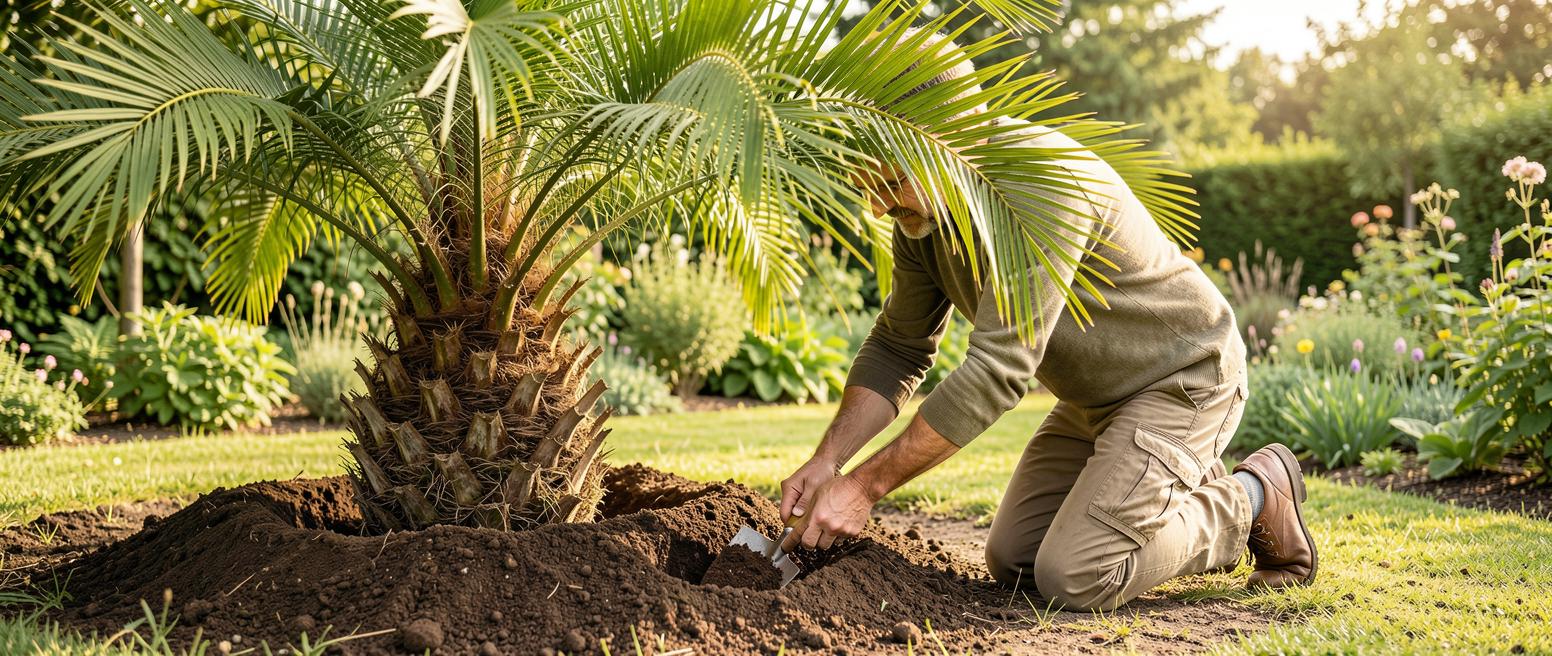
Of the approximately 4000 palm species, a smaller selection is cultivated by humans, for their strength, appearance, fruit, or utility. From that selection come the species that can withstand our winters outdoors, from 10 cm to over 10 meters tall.
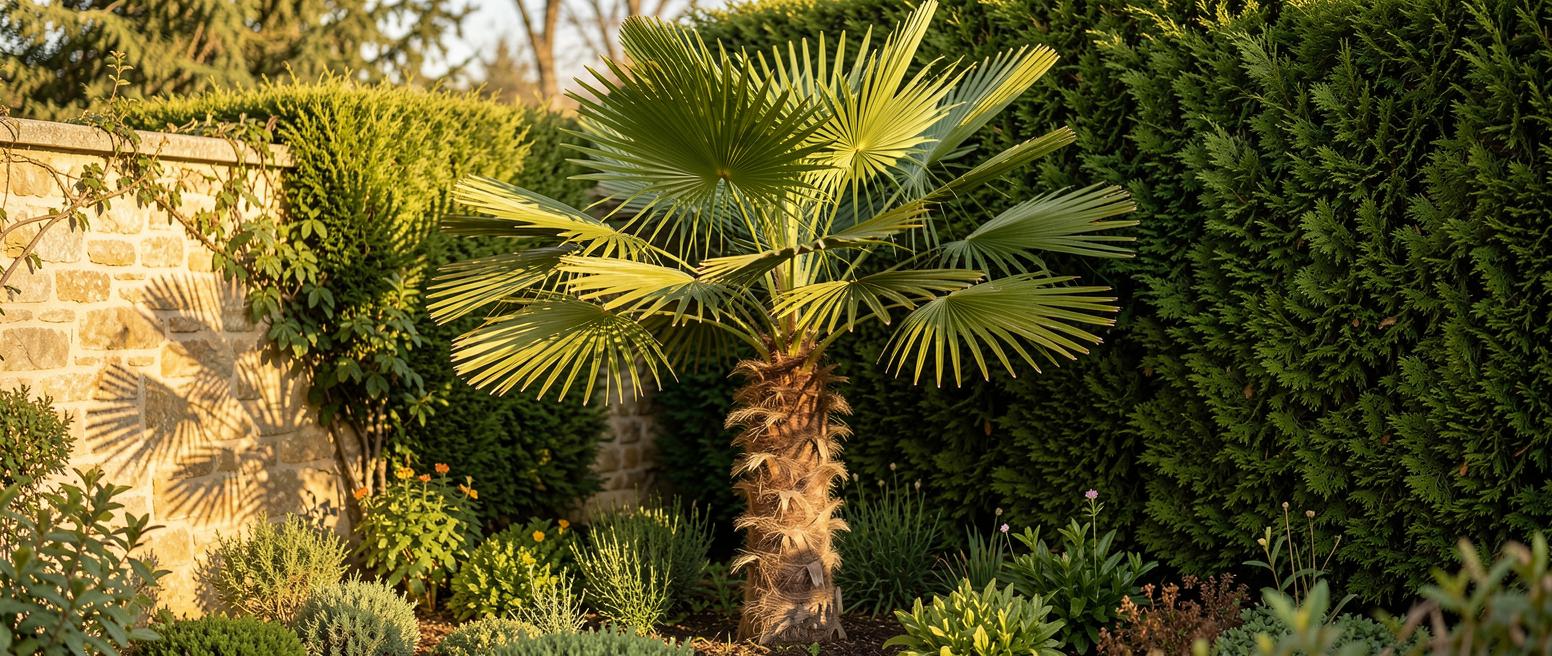
Trachycarpus fortunei, the windmill palm
Our best-selling palm, originating from the Himalayas of North India to North Thailand and China. It thrives excellently in the Netherlands, immediately gives a tropical impression, and produces yellow seed clusters.
Phoenix canariensis, the Canary Island date palm
Popular because smaller specimens are affordable while still tolerating up to about 6 degrees of frost. Eventually, it forms a thick trunk and becomes very tall and imposing. Larger specimens yield edible, sweet dates.
Chamaerops humilis, the European fan palm
Originally from the mountains of Morocco to Spain, France, and Eastern Turkey. Graceful, relatively fast-growing, and with a limited final height in our climate. Hardy to approximately -13 °C, and ideal in a pot if you can move it into a shed on the coldest days.
Chamaerops humilis 'Vulcano'
The same family, but with more compact and stiffer leaves, making it more resistant to wind. Remains smaller and grows slower than the regular humilis.
Brahea armata, the Mexican blue fan palm
From Mexico, California, and Sonora, with deeply incised silver-blue leaves. In bloom, countless cream-colored flowers hang down on meter-long branches. Grows slowly but flowers young; a large specimen in the ground tolerates up to about 5 degrees of frost, more as it stands drier.
Phoenix dactylifera, the date palm
The oldest known cultivated palm, with a thick trunk and real edible dates.
Cold and moisture work together. Almost every palm tolerates a few more degrees of frost if it is kept dry, so winter protection is as much about keeping rain out as it is about insulation.
Tropical palm trees
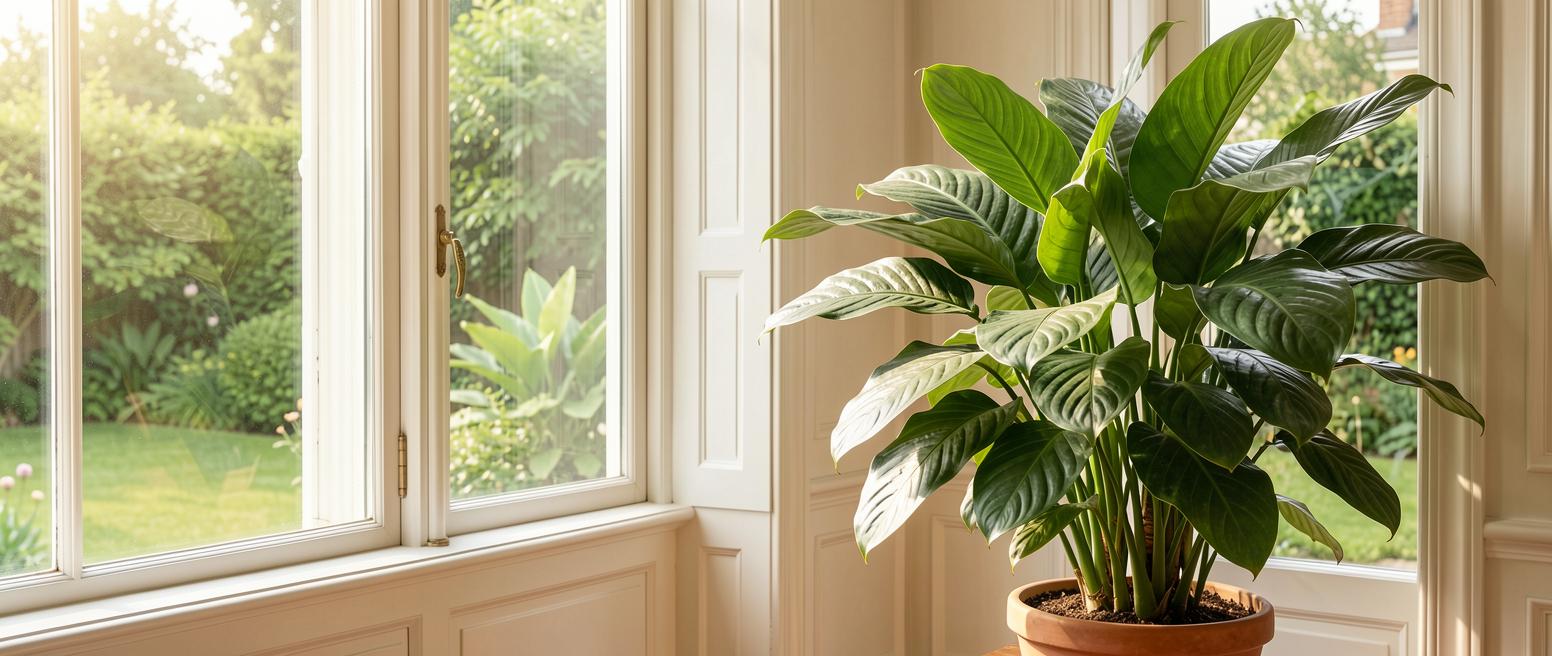
If you have a heated room, a conservatory, or a bright living room, the assortment opens up considerably. We also supply many species that do not survive the Dutch winter outdoors.
These are the palms you know from jungles and hotel lobbies: taller, fuller, and often with pinnate leaves instead of fan-shaped leaves.

Olive trees
Olive trees are almost indispensable in a Mediterranean garden. Older specimens develop gnarled trunks that look like something out of a fairy tale, and after a pickling process, the olives are edible. We carry them in a range from small to ancient.
- Miniature trees: in a decorative pot, for a mantelpiece or windowsill. Too young for winter outdoors.
- Young trees with slender trunk: slender silhouette with a dense crown, beautiful in an ornamental pot.
- Tall slender olive tree: grown tall, but still with a thin trunk.
- Thicker trunk formation: older but not necessarily taller, with a larger crown and distinctly stronger.
- 'Old wood': often older than ourselves, with characteristic gnarled trunk and substantial crown.
- Fairy tale trees: hundreds of years old, sometimes close to a thousand. Enormous survival capacity.
- Heavily branched fairy tale trees: the top class, with exceptional growth form.
- 'Pon Pon': shaped and pruned into loose round canopies, suitable for themed gardens and large projects.
Bamboo
Bamboo grows quickly, requires little maintenance, and is exceptionally strong. Hard, hollow culms in yellow, brown, red, or black immediately give a garden a Mediterranean atmosphere. There is one choice you must make carefully beforehand: clumping or spreading. Spreading varieties multiply like weeds and can take over entire sections of the garden without a root barrier.
- Fargesia 'Rufa': gray-yellow stems, full and fresh green leaves.
- Fargesia 'Jiuzhaigou': remains green in winter, very hardy, stays under 300 cm with small elegant leaves.
- Fargesia nitida 'Black Pearl': dark purple to almost black stems, grows somewhat wider, up to 250 cm. Beautiful as a solitary plant or loose hedge.
- Fargesia nitida 'Winterjoy': dark stems and fresh green leaves, cultivated in the Netherlands and therefore resistant to severe frost. Stays at 350 to 400 cm and is ideal as a hedge.
- Fargesia nitida 'Vulcano': green-black culms that bend slightly into a fountain shape. Fast-growing, fully hardy, non-spreading.
- Pleioblastus variegatus: dwarf bamboo from 50 to 80 cm with white-green leaves, suitable as dense ground cover. Hardy to approximately -20 °C.
- Phyllostachys aureosulcata 'Spectabilis': yellow culms that turn red in the sun. Naturally grows in clumps, so strong as a hedge or in a pot as a living screen.
Flowering Mediterranean plants

This group ranges from fully hardy to distinctly tropical. Therefore, pay close attention to the lower temperature limit for each species, as this is where you'll find the plants that need to be brought indoors in time.
Strelitzia nicolai and reginae
The bird of paradise flower, with sturdy leaves that remain green all year round and a flower that only appears after several years. The two species differ in leaf shape; the leaf resembles that of a banana plant, but stiffer. Can be kept outdoors in spring and summer down to approximately +6 °C.
Heliconia 'Hawaii'
Looks like a cross between a reed palm, bird of paradise flower, and banana plant. Grows relatively fast, flowers all year round, and loves high humidity and plenty of water. Place it outdoors during the day in summer, but bring it indoors as soon as the temperature drops below 10 °C.
Canna indica, tropical canna lily
Resembles the red banana plant and provides a lush floral display in summer and late summer. Grows to about 80 cm tall in a pot or in the ground and mainly requires fresh water every few days.
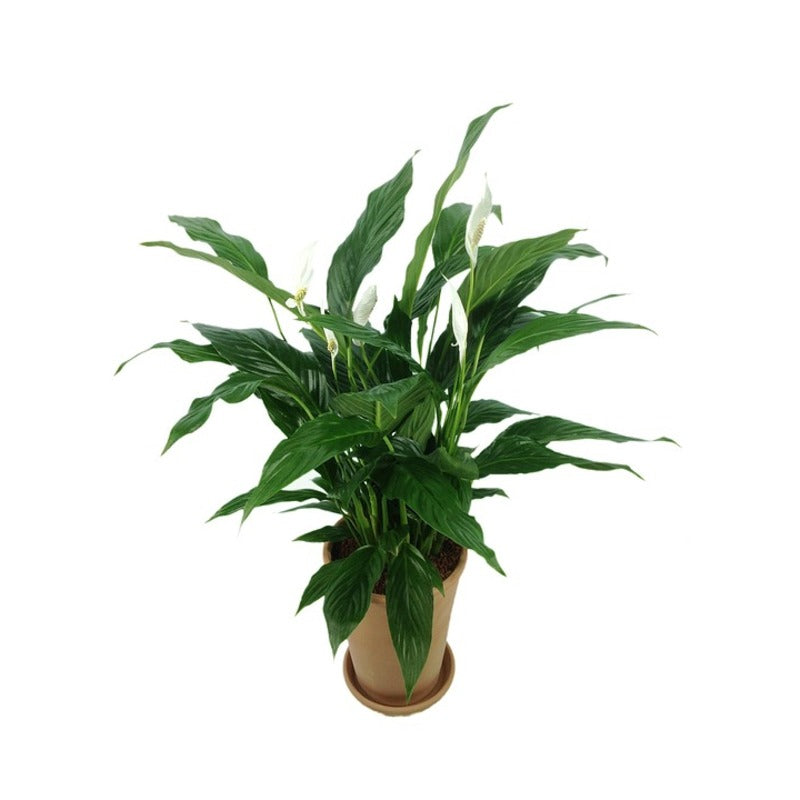
Spathiphyllum, the peace lily
One of the strongest houseplants, with dark green leaves and a spoon-shaped flower that repeats itself throughout the year. Pull out spent stems; new flowers will then appear. Also purifies the air in the room.
Nerium oleander
Available in pink, red, and white, also with double and filled flowers. Originally from the Mediterranean region to Japan. Prefers full sun, but partial shade is also possible.
Oleanders are often referred to as hardy elsewhere. They are not, or barely: bring them indoors during the cold period.
Brugmansia, the angel's trumpet
A patio plant with large hanging flowers in various colors. Not hardy, prefers to overwinter indoors in a cool, bright place. Needs a lot of water and should never be left dry for long.
Syringa vulgaris 'Sensation', the lilac
Fully hardy and abundantly flowering, the easiest choice in this group.
Albizia julibrissin, the Persian silk tree
Grows into a tree with striking flowers in various colors. The leaves fold at night for protection.
Lonicera henryi, honeysuckle
Flowering shrub with graceful, colorful blossoms and sweet nectar.
Cycads and fig trees
Two groups that at first glance don't seem to belong anywhere, but both have a fixed place in the assortment.
Cycads
An ancient genus that has existed for a very long time and strongly resembles palm trees, but is officially not a palm. We supply one species, also known as the peace palm: a trunk with leaf stems in a circle, each covered with small, narrow, sturdy leaves. It cannot tolerate frost well, so bring it indoors before it starts freezing seriously.
Fig trees, Ficus carica
Decorative and edible: sweet figs full of vitamins and minerals. Fits just as well in a Mediterranean garden as in a regular Dutch garden, and bringing it indoors is not a problem.
How to choose the right plant
Most disappointments are not due to care, but to a mismatch between plant and location. Therefore, first assess the location, then the assortment.
Which group suits your location
Evergreen and hardy. Plant well once, then little work.
Movable, so you can put them under cover on the coldest days.
Fill a garden within one or two seasons. Requires more water and attention.
Light and warmth all year round. No frost, but regular water and nutrients.
If you are in doubt between two species, look at their hardiness and final size. Both are listed on each product page, along with the recommended location. This prevents having to move a plant later that turned out to be too large or too sensitive.

Can't figure it out?
Send us a photo of the spot you want to fill, with the dimensions. We'd be happy to help you choose the best species and size for that spot.
Ask your question
Share:
Providing your plant with good nutrition
Applying hydroponics to your plants